

Zero Sperm Count (Azoospermia): Can I Still Become a Father?
No sperm found in your semen? Your DNA may hold part of the answer.

Receiving a semen report showing zero sperm count can be overwhelming. You may wonder whether you can ever become a biological father.
Zero sperm count, medically known as azoospermia, does not necessarily mean that biological fatherhood is impossible. Understanding the underlying cause is an important first step.
Why is my sperm count zero?
There are two main types of azoospermia:
- Obstructive azoospermia: Your testes produce sperm, but a blockage or missing tube prevents them from reaching the semen.
- Non-obstructive azoospermia: Your testes have difficulty producing sperm.
Hormonal problems, infections, previous medical treatments and genetic conditions can contribute to azoospermia. Your doctor may recommend a repeat semen analysis and further investigations to identify the cause.
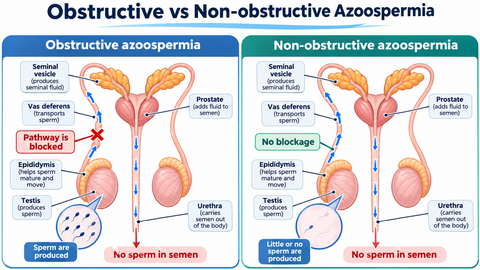
Illustration of obstructive versus non-obstructive azoospermia.
Can I still become a biological father?
In some cases, yes!
Specialised procedures such as TESA, TESE and micro-TESE may allow doctors to retrieve sperm directly from the reproductive tract or testes for fertility treatment through ICSI.
However, success depends on the underlying cause. Certain genetic conditions can make sperm retrieval extremely unlikely to succeed.
Identifying these conditions beforehand may help you make informed decisions about fertility treatment.
Could my azoospermia be genetic?
Even if your hormone levels, chromosome analysis (karyotype) and Y chromosome microdeletion tests are normal, an underlying genetic cause may remain undetected.
Researchers at FRIGE Institute of Human Genetics, Ahmedabad and Decipher DNA, led by Dr. Harsh Sheth investigated 247 Indian men with severe male infertility. Our published research demonstrated that our state-of-the-art patented DNA sequencing technology can identify additional genetic causes that conventional tests may miss.
Additionally, our research at FRIGE Institute of Human Genetics, in collaboration with international research groups, has investigated the genetic causes of male infertility in men from other populations.
Published in internationally recognised scientific journals, including Nature Communications, Human Fertility, and the Journal of Assisted Reproduction and Genetics, these studies highlight how advanced DNA sequencing can uncover genetic causes of infertility that conventional tests may miss.
Read about our published research.
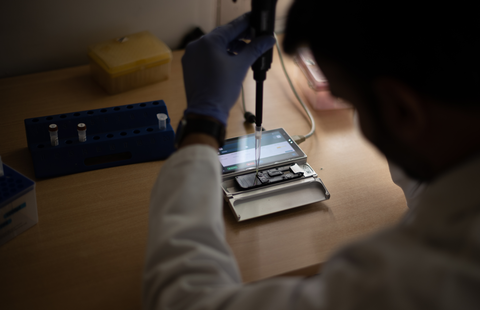
Advanced DNA sequencing to investigate the genetic causes of male infertility.
How can genetic testing help me?
FRIGE offers comprehensive male infertility genetic testing using advanced DNA sequencing technology.
Depending on the findings, genetic testing may help you:
- Understand the underlying cause of your azoospermia.
- Make informed decisions before TESA, micro-TESE or IVF.
- Understand potential genetic risks to future children.
- Explore appropriate reproductive options.
Only a blood sample is required for the genetic test.
Test code: NGS-2
Expected reporting time: 21 days
Take the next step
Your semen report shows the problem. Could your DNA help explain it?
Speak to our genetics team to find out whether comprehensive male infertility genetic testing is right for you.
FRIGE Institute of Human Genetics, Ahmedabad
Call: +91 79 2692 1414 / 1415
Enquire about genetic testing and its cost.